Stereoscopic Kashmir 
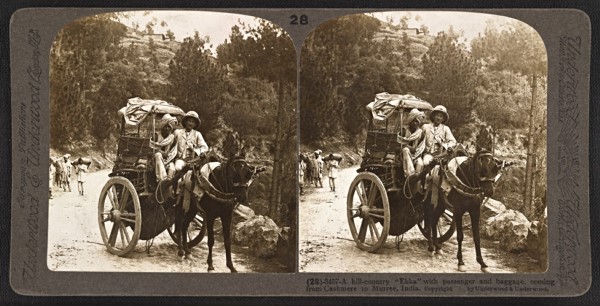
In an unusual burst of creativity triggered by the boredom of Sunday's curfew, I decided to try my hand at animating old stereogram images of Kashmir.


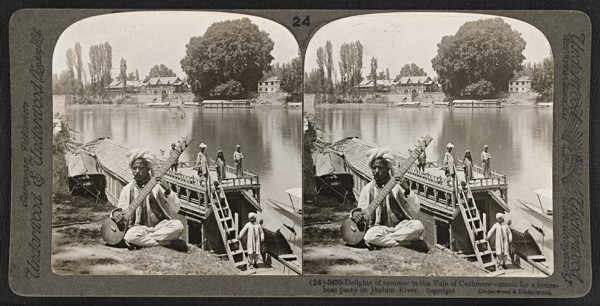
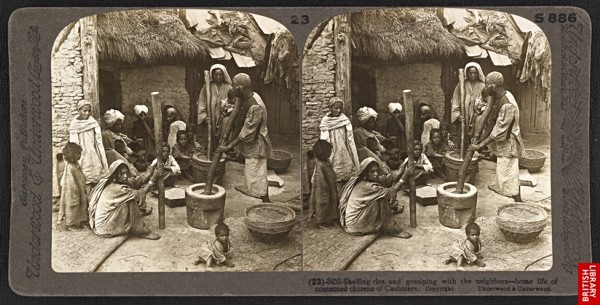
The technique I used is called Wiggle Stereoscopy. These photographs use animation [animated GIFs in this case] to produce a 3D effect by alternating the left and right images of old stereogram images of Kashmir, originally intended to be viewed in a Stereoscope.

We can imagine the scene as the photographer must have pictured it in his 'mind's eye'. The images may be somewhat jerky but it is a unique method to create the illusion of depth in photographs. Plus no special 3D glasses are needed :-)

Enjoy.


A Sahib in his Ekka.


Sitar Player.


Village life.


Hopscotch.

[ 1 comment ] ( 2 views )   |  [ 0 trackbacks ]   |  permalink  |   ( 0 / 0 )
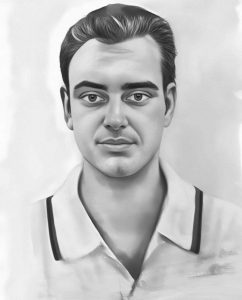
No Caption Needed 

image © www.greaterkashmir.com


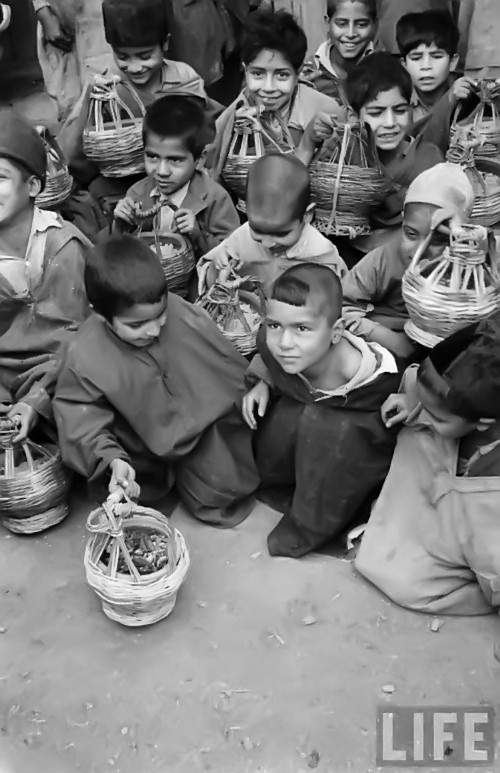
If ever a picture said a thousand words...

This photo is from today's edition of the Greater Kashmir online newspaper. I used contribute occasionally to Greater Kashmir a few years back but discontinued partly because I did not agree with some of their editorial policies.

There is no denying however that Greater Kashmir has matured enormously from its earlier days and I admire its vigorous championing of environmental and heritage issues. It is the leading English-language daily of the valley and also the main source of homeland news for the Kashmiri diaspora.

Besides, Greater Kashmir features the enormously talented Malik Sajjad . Malik Sajjad has a uncanny ability to sketch whatever is uppermost on the minds of his people, much like his senior Bashir Ahmed Bashir of the Urdu-language daily Srinagar Times.

It has been years since I read that paper, but I recall how one could instantly grasp the meaning behind the Srinagar Times cartoons even without reading the caption. A wag once commented that the artist should have been dubbed Bashir Ahmed 'Kashir'. Malik Sajjad is a worthy inheritor of that mantle.

With apologies to Ghalib:
Dekhna tasveer [taqreer] ki lazzat ke jo usne likha [kaha]
Main ne yeh jaana ke goya yeh bhi mere dil mein hai


Malik Sajjad has his own website at www.kashmirblackandwhite.com and it is well worth a visit.

[ add comment ]   |  [ 0 trackbacks ]   |  permalink  |   ( 2.9 / 12 )
Faiz vs Ghalib 
Sorry for yet another blogging hiatus. I did write a few posts but did not publish them online. Somehow the relevance of one individual's thoughts seemed to be blown away by the turbulence of the past weeks. Insignificance in an Orwellian nightmare.

Thses days all thoughts and discussions inevitably veer around to the state of things in the valley. A comment on a previous post and a pointed reference to Faiz Ahmed Faiz for my benefit resulted in today's post. A poetry-spouting friend addressed me thus:

Bol, ki lab azaad hain tere
bol, zubaan ab tak teri hai


For my readers benefit:

Bol
by Faiz Ahmed Faiz

Bol, ki lab azaad hain tere
bol, zubaan ab tak teri hai
tera sutwan jism hai tera
bol, ki jaan ab tak teri hai
dekh ki aahan-gar ki dukan mein
tund hain sholay, surkh hai aakhan
khulne lage quflon ke dahaane
phaila har ik zanjeer ka daaman
bol, ki thoda waqt bahut hai
jism-o-zuban ki maut se pehle
bol, ki sach zinda hai ab tak
bol, jo kuchh kehna hai kehde


From the depths of memory, Ibn e Insha seems to mock me further:

Khamosh Raho

by Ibn e Insha

kuchh kehne ka waqt nahi hai kuchh na kaho khamosh raho
ae logon khamosh raho, haan ae logon khamosh raho

sach achchha hai, par is ki jadon main, zehr ka ek pyala bhi hai
pagal ho, kyun nahaq ko "suqraat" bano, khamosh raho

haq acha par is ke liye koi aur marey to aur achchha hai
tum bhi kya "mansoor" ho jo sooli pai charho, khamosh raho

un ka yeh kehna sooraj hi dharti kai pherey karta hai
sar ankhoon par, sooraj hi ko ghoomne do, khamosh raho

garm ansoo aur thandi aahen, man main kya kya mausam hain
is bagiya ke bhed na kholo, sair karo, khamosh raho

ankhian moond kinare baithoon, man ke rakhoon band khewar
insha ji lo dhaga lo, aur lab si lo, khamosh raho


Fortunately Ghalib , with his genius for having penned a verse for every occassion, springs to my defence:

Bana kar fakiron ka hum bhes ghalib
Tamasha-e-ahle-karam dekhte hain


Faiz and my friend[?] team up again for a parting shot.

Hum Dekhenge

by Faiz Ahmed Faiz

hum dekhenge
lazim hai ke hum bhi dekhenge
wo din ke jis ka wada hai
jo lauh-e-azl mein likha hai

jab zulm-o-sitam ke koh-e-garan
rooi ki tarah ur jaenge
hum mehkoomon ke paaon tale
ye dharti dhar dhar dharkegi
aur ahl-e-hakam ke sar oopar
jab bijli kar kar karkegi

jab arz-e-Khuda ke kaabe se
sab but uthwae jaenge
hum ahl-e-safa mardood-e-haram
masnad pe bethae jaenge
sab taaj uchale jaenge
sab takht girae jaenge

bas naam rahega Allah ka
jo ghayab bhi hai hazir bhi
jo manzar bhi hai nazir bhi
utthega an-al-haq ka nara
jo mai bhi hoon tum bhi ho
aur raaj karegi khalq-e-khuda
jo mai bhi hoon aur tum bhi ho


P.S : Translations of these poems are available here .

[ 1 comment ] ( 6 views )   |  [ 0 trackbacks ]   |  permalink  |   ( 3 / 10 )
Ain Jalut - A Page From History 
In the thirteenth century [7th century Hijri], a vast Mongol/Tartar horde numbering 300,000 warriors commanded by Hulagu Khan [Halaku] captured and razed Baghdad to the ground in a week-long massacre. The Mongols cut a swathe through three quarters of the Muslim lands, destroying the Abbasid caliphate and occupying Damascus. It was the most devastating sequence of events in the history of Islam. With the destruction of Baghdad and Damascus , the two greatest centers of Islam, only Cairo , the seat of the real military power of Islam under the Mamluks, remained unconquered.

Saif-ud-din Qutuz , the Mamluk ruler of Egypt, recieved a chilling message from Hulagu:

From the King of Kings of the East and West, the Great Khan.

To Qutuz the Mamluk, who fled to escape our swords.

You should think of what happened to other countries and submit to us. You have heard how we have conquered a vast empire and have purified the earth of the disorders that tainted it. We have conquered vast areas, massacring all the people. You cannot escape from the terror of our armies.

Where can you flee? What road will you use to escape us? Our horses are swift, our arrows sharp, our swords like thunderbolts, our hearts as hard as the mountains, our soldiers as numerous as the sand. Fortresses will not detain us, nor arms stop us. Your prayers to God will not avail against us. We are not moved by tears nor touched by lamentations. Only those who beg our protection will be safe.

Hasten your reply before the fire of war is kindled. Resist and you will suffer the most terrible catastrophes. We will shatter your mosques and reveal the weakness of your God, and then we will kill your children and your old men together.

At present you are the only enemy against whom we have to march.

When Salah-ud-Din Ayubi (Saladin) founded the Ayubid dynasty in 1174 AD, he formed an elite military corps of slaves called the Mamluks . In 1254 AD, the Mamluks under Aybak revolted and transformed themselves from slaves to rulers. They too had a formidable reputation as warriors, and despite being heavily outnumbered Sultan Qutuz decided to resist. He started making preparations to defend Cairo against seemingly inevitable destruction. However, divine intervention in the form of the death of the Great Khan Mongke, forced Hulagu to return home to decide his successor as per Mongol tradition. A supremely confident Hulagu ordered a force of 20,000 men under Kitbuqa/Katabgha to attack Egypt. Once again Qutuz acted decisively and ordered his army to march out to attack the Mongols. The Crusaders, though bitter foes of Islam, recognised the Mongols as a greater common threat and allowed the the muslim army safe passage and access to supplies.

The two armies met on the 3rd of September 1260 AD at Ain Jalut (Springs of Goliath) in modern day Palestine. The Muslim army was at risk of being overrun when Qutuz rode to the thick of the action and launched a fierce attack on the Mongols. Shouting ' O Muslims! / Wa Islamah! ' he threw away his helmet so his warriors could recognize him. His actions had the desired effect and inspired his warriors to defeat the Mongols in close combat, something that no army had previously done.

The clash between Mamluk and Mongol armies at Ain Jalut seven centuries ago was one of the most significant battles of world history. The empire of Islam was within a few sword strokes of being wiped out and Europe had already been invaded through Poland. By smashing the myth of Mongol invincibility the Mamluks secured the future of both the Islamic and western civilizations as we know them today.

An interesting sideline is that within 35 years of the battle, Islam had managed to assimilate the Mongols. Hulagu Khan became embroiled in internecine battles with his cousin Berke Khan who had converted to Islam, and never threatened these lands again. Ghazan Khan, ruler of one of four descendant empires of the Mongol Empire (Ilkhanate), converted to Islam after his enthronement in 1295. The Great Mughals , who claimed descent from Genghis Khan, ruled most of the Indian subcontinent from the early 16th to the mid-19th centuries.


Image © Chester Beatty Library

[ add comment ]   |  [ 0 trackbacks ]   |  permalink  |   ( 3 / 5 )
The Day That Music Died 
I believe that Nusrat Fateh Ali Khan [NFAK] is the greatest singer who has ever lived. I love music. Any kind at all. Yet if all the music in the world, except that of NFAK (and trad.kashmiri music ;-), were suddenly to vanish I would not mind at all. One of the greatest regrets of my life is that I never could attend a live concert by NFAK even when I could have. I guess I was hoping for him to perform in Kashmir - ecstatic sufi poetry in NFAK's divine voice in Kashmir would have been an experience to cherish forever. There could have been no finer backdrop for his mesmerising voice than the exquisite beauty of a land steeped in sufi mysticism.

When I am really in the mood for music, a typical session invariably starts off with NFAK, moves on to Aziz Mian then switches over to kashmiri in Hassan Sofi's ethereal voice, and finally to traditional kashmiri folk with Rashid Hafiz and Ghulam Ahmed "Am" Sofi.

Back to Nusrat Fateh Ali Khan. He intially achieved enormous popularity with his magnificent qawwali singing but by the time he died his fame had traversed continents as one of the greatest crossover artists of world fusion music. Singing Buddha , as he was known in Japan, is an especially apt description of his live performances.

From Wikipedia : Nusrat's music invites us to eavesdrop on a man communing with his God, ever so eloquently. He makes the act of singing a passionate offering to God. But we do not merely eavesdrop. The deepest part of Nusrat's magic lies in the fact that he is able to bring our hearts to resonate with the music, so deeply, that we ourselves become full partners in that offering. He sings to God, and by listening, we also sing to God.

Time Magazine listed NFAK as one of the Top 12 Artists and Thinkers in their 60 Years of Asian Heroes issue. From the article: Khan had made the rich religious poetry of the Sufi tradition even more magical, bringing words and music together in an ecstatic celebration of the divine. To listen to him was to hear the harmony of the spheres.

National Geographic comments on the ...nearly superhuman vocal abilities, extraordinary improvisational skills or the enduring love that millions of fans lavished upon Nusrat Fateh Ali Khan. The same article also reveals how NFAK agreed to all kinds of projects and collaborations, overlooked unauthorized releases - and even sang into personal tape recorders for just about anyone who would ask, though he knew that those bits would probably soon be pirated - with the justification that any recording, "legitimate" or not, would help spread the Sufi word of universal peace and love. Face of Love with Eddie Vedder and Gurus of Peace with A R Rahman are prime examples of this foresight.

August 16 marks the 11th death anniversary of Nusrat Fateh Ali Khan.

R.I.P, Ustad.


[ add comment ]   |  [ 0 trackbacks ]   |  permalink  |   ( 3 / 5 )

| 1 | 2 | 3 | Next> Last>>